

By Chad Kimner, COO, Visiting Media
Show a couple thousand American travelers two photos of a lake, one real and one generated, and 22 percent pick the real one. Another 23 percent pick the generated one. Those two numbers sit within a point of each other, which is roughly what guessing looks like. Before the test, 52 percent of the same group said they were extremely or very confident they could spot AI imagery.
I should say what that survey is before I lean on it. It covers destination photos, not hotel rooms, and the state tourism board that paid for it launched a real-photo certification program alongside the results.
What I take from it is simpler than the headline. Seventy-four percent of those travelers said they would not book a trip without seeing photos first, and seven in 10 said they had arrived somewhere that looked noticeably different from what they had planned around. So people rely on the photo, cannot reliably check it, and have already been burned. The photo is the listing. If the person looking can’t tell what’s real, the checking falls to whoever published it.
What the hotel numbers do and don’t say
A German agency and a forensic AI firm looked at 25,550 photos from 700 hotels in seven destinations in May and flagged about 19 percent of them for at least one sign of AI generation or editing. City hotels ran higher: 36 percent in Hamburg and 27 percent in Berlin.
I would not quote any of those figures as the share of fake hotel photos. A flag can be a metadata marker as easily as a visual oddity, the analysis does not separate fully generated images from enhanced ones, and the report itself suggests that landmark shots, such as a TV tower, may be pushing the city numbers up. Both firms also sell something that benefits from the finding.
Still, a number like that has an effect on a reasonable guest who sees it in the news. After reading it, anyone looking at a lobby photo has a new question, and the property has no easy way to answer it.
Banning AI from photography won’t hold
The tempting reaction is a flat rule: no AI in anything a guest sees. I understand it, and I don’t think it survives a week of real marketing work.
Photos have always been retouched. Exposure gets corrected, a stray cable disappears, a window that blew out gets pulled back. Any rule written as “no AI” will be broken by a photo editor doing what they did last year, now with a different tool.
Tennessee’s tourism department, the sponsor of that survey, wrote something more useful into its certification. Minor retouching is allowed when it better reflects what is already there, and the department says travelers will never see AI alterations that add, remove or change reality. I think that is close to the right line. It has a gap: nothing on that list says what to do about an image that was never meant to show what is there at all.
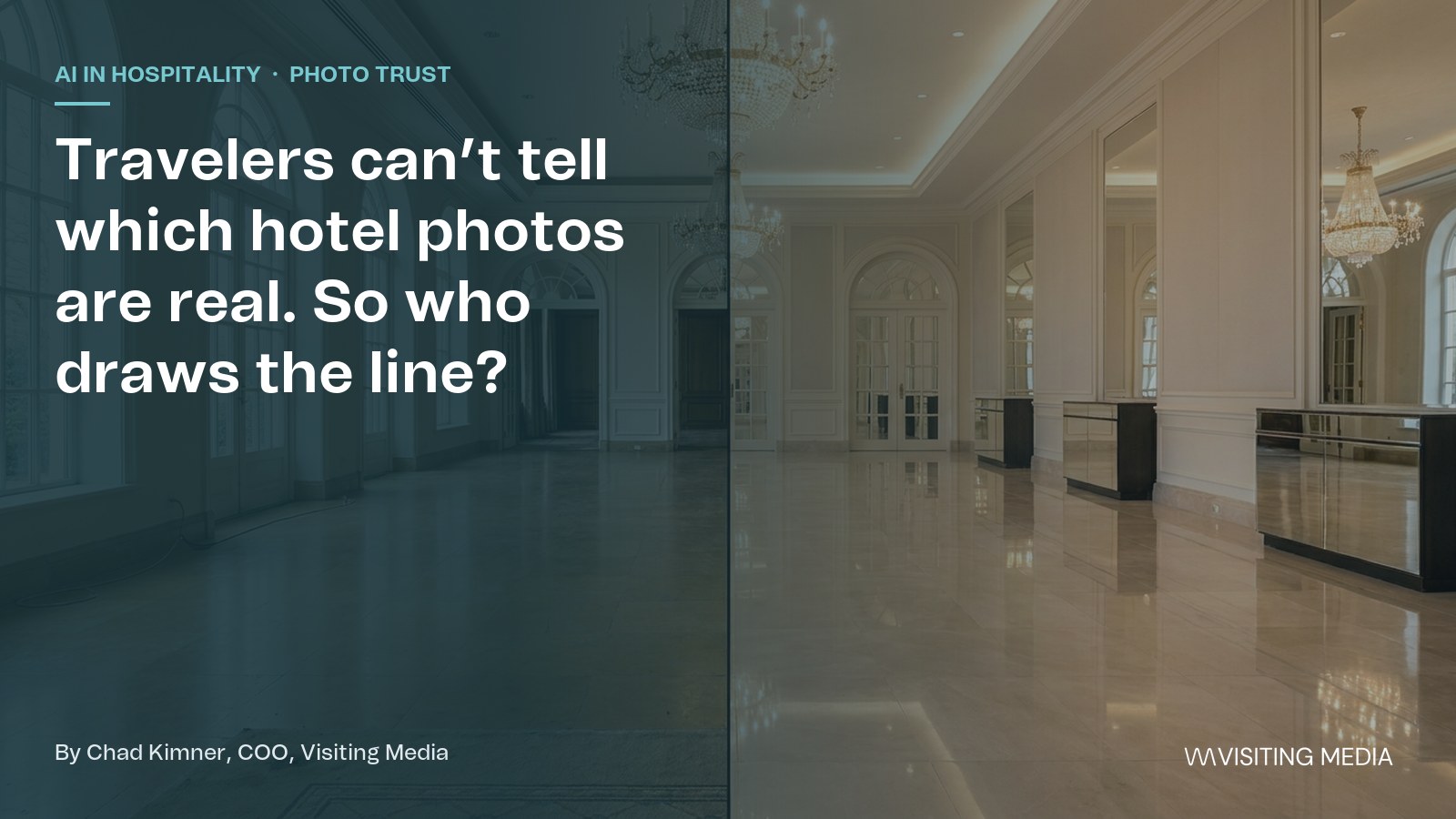
Think about a ballroom picture dressed for an awards night that hasn’t happened yet, in a client’s colors, with a stage that isn’t built. That image is useful to a planner. It helps her imagine her event in the room. It only becomes a problem when it is presented as the room. The same pixels are fine under one caption and misleading under another, which is why the standard needs to cover how an image is labeled as well as how it was made.
Three questions to ask before an edited image goes live
This is not an exhaustive list, and I haven’t touched video, virtual tours or guest-submitted photos. This is simply the minimum I would want answered by any photographer, agency or tool a property works with:
- What does this edit add, remove or change in the physical space a guest will walk into? If the answer is anything a guest would notice, the image shows something that isn’t there.
- Is the image presented as the room as it is, or as the room as it might be, and does the page say which? A label that lives in a file’s metadata does not count if the guest never sees it.
- Can a guest get to the unedited version? Seventy percent of the travelers surveyed said they would be more likely to trust imagery from a destination that confirms it is real, so the answer to this one is a sales point as well as a safeguard.
If you disagree about where the line sits, I would like to hear it. I’m certain about the second question. A label that is technically present and practically invisible is a hard thing to define, and I haven’t seen anyone get it right yet.
One assignment before the next time you plan a campaign. Open your own listing on a booking site and go through the photos one at a time. For each, decide whether you would put its caption in writing and stand behind it if the guest checked in and asked for a refund. Whatever fails that test is where the work starts, whether or not AI was involved.